
A Practical Outreach Scoring System for B2B Link Building
How to decide who to email, who to nurture, who to submit by form, and who to skip
Manual outreach works better when prospect selection is treated as a decision system rather than a list-building exercise. The biggest waste in link building rarely comes from writing the email. It comes from contacting sites that were never good prospects in the first place.
In our current outreach workflow for B2B SEO, I use a small scoring model before sending the first message. The goal is not to predict acceptance perfectly. It is to allocate effort: which sites deserve a personalized email now, which deserve relationship-building, which require an official submission form, and which should be skipped entirely.
1. Start With Topical Relevance
Authority metrics are useful filters, but relevance comes first. A smaller publication that consistently covers B2B SEO, WordPress, SaaS growth, demand generation, or international marketing can be more valuable than a much larger general-interest site.
I score relevance on a simple 1–5 scale:
- 5: the site regularly covers the exact topic and audience.
- 4: the topic is adjacent and the readership overlaps strongly.
- 3: broad business/technology relevance but weak audience fit.
- 1–2: mainly unrelated; skip unless there is a specific editorial angle.
2. Check Editorial Quality Before Authority
Before looking at a domain score, open recent articles. Are they edited? Do they have real authors? Are posts internally linked? Is the site dominated by obvious paid placements across unrelated niches? Does the content look maintained?
This editorial check protects you from a common mistake: buying or pitching a metric instead of earning a useful placement. A contextual link inside a credible article is more valuable to readers than a link on a page that exists only to sell placements.
3. Use Authority as a Risk Filter, Not a Goal
Metrics such as Authority Score, referring domains, and organic visibility help identify whether a site has a real footprint. I use them to detect extremes rather than to rank every prospect precisely. Very low authority and no real traffic are warning signs. Extremely high authority with no realistic editorial access is often a poor use of outreach time.
The practical middle is a site with enough authority to matter, a relevant audience, active publishing, and a reachable editorial route.
4. Score Reachability
A great website with no valid outreach path is not an immediate prospect. I separate contactability into four categories:
- Direct editorial email: highest priority when the address is publicly designated for pitches.
- Official contributor form: high quality, but must follow the form rather than inventing an email route.
- Relationship-first: contributor access depends on partnership, seniority, or prior engagement.
- Protected/uncertain contact: keep in the research queue until the official route is verified.
This prevents a surprisingly common outreach error: sending guest-post requests to support, sales, or generic inboxes when the site explicitly provides a different route.
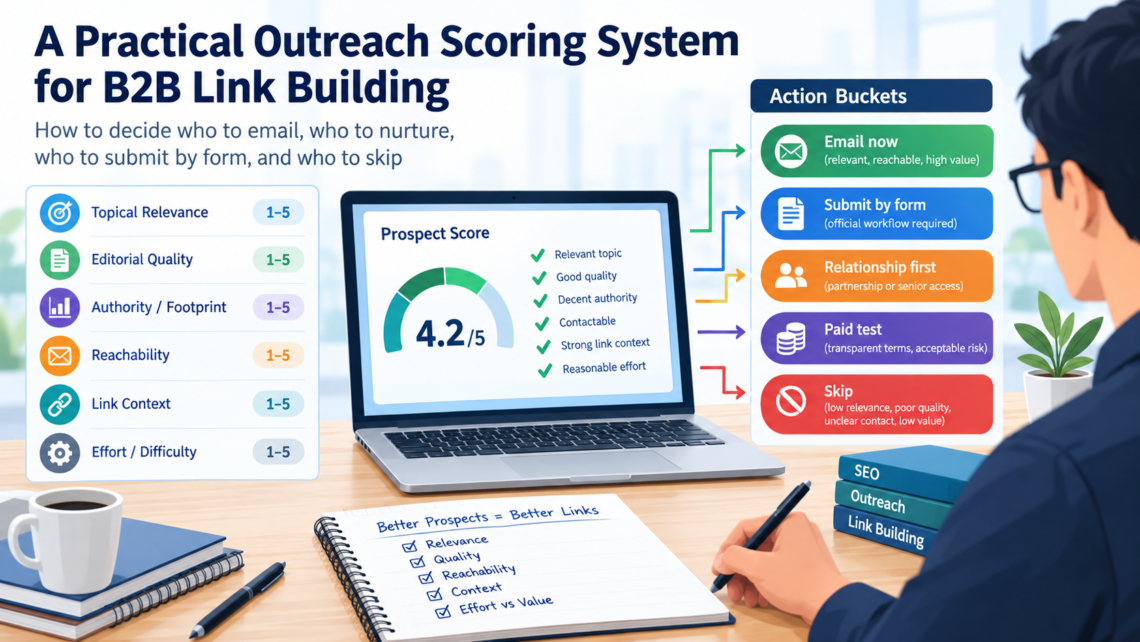
Figure: A simple prospect-scoring flow used before manual outreach.
5. Evaluate the Link Context
Not every accepted placement has the same value. Before investing time or money, clarify where the link will live. I prefer links that are editorially relevant to the surrounding paragraph and point to a useful resource, not an exact-match commercial anchor forced into unrelated copy.
Natural branded and descriptive anchors are usually safer and more useful. That principle is consistent with our own 2026 backlink-building framework, which prioritizes relevance, real traffic, contextual placement, and editorial credibility over raw link volume.
6. Add an Effort-to-Value Score
Two prospects can have similar quality but require very different effort. One may accept a concise pitch by email. Another may require a 2,000-word completed article, headshot, multiple social profiles, and a detailed author application before an editor even reviews the idea.
I therefore add a difficulty score and ask: if this works, is the expected value worth the preparation? High-effort targets can absolutely be worthwhile, but they should compete for time against easier high-quality opportunities rather than being treated equally.
7. Put Prospects Into Action Buckets
After scoring, every prospect should end up in an action bucket, not just a spreadsheet row:
- Email now: relevant, credible, reachable, and pitch-first.
- Submit by form: strong opportunity, but the site requires an official workflow.
- Relationship first: access depends on partnership, contributor status, or senior expertise.
- Paid test: relevant site with transparent commercial terms and acceptable risk.
- Skip: weak relevance, weak quality, unclear contact route, or poor value for effort.
8. Personalize the Pitch Around the Reader Problem
Once a prospect passes the score, the email should be short and site-specific. I usually lead with one concrete reader problem, a working title, a short explanation of the angle, and one relevant writing sample. I do not lead with “I want a backlink.” The link is a by-product of publishing something useful.
For example, a lead-generation publication should receive a conversion or pipeline angle, while a WordPress publication should receive a performance, architecture, or implementation angle. Reusing the same generic title across every site lowers both reply quality and editorial fit.
9. Track Outcomes Beyond Reply Rate
Open rate is not the final metric. A better outreach dashboard tracks positive replies, editorial acceptance, cost, publication time, live URL, link attribute, traffic/referral potential, and whether the relationship can support future contributions.
Over time, this creates a feedback loop: which prospect characteristics actually lead to accepted, useful placements? The scoring model should change based on that evidence.
A Simple Scoring Template
| Factor | Score | What to check | Weight |
| Topical relevance | 1–5 | Audience and topic overlap | High |
| Editorial quality | 1–5 | Recent posts, authors, maintenance | High |
| Authority / footprint | 1–5 | AS/DR, referring domains, traffic | Medium |
| Reachability | 1–5 | Official pitch email or form | High |
| Link context | 1–5 | Contextual, useful, natural anchor | High |
| Effort / difficulty | 1–5 | Assets and time required | Medium |
The exact math matters less than consistency. The system is useful because it forces the researcher to explain why a prospect deserves outreach before spending time on the pitch.
Conclusion
Good manual link outreach is selective by design. The goal is not to maximize the number of emails sent. It is to maximize the share of outreach going to sites where relevance, editorial quality, contactability, and context are all strong enough to justify the effort. A simple scoring model makes that discipline repeatable.
Author bio: Lifeng works with Zheshan Tech on international SEO, B2B website growth, and manual outreach for export-focused businesses. He focuses on practical prospect research, website architecture, content strategy, and link acquisition workflows.