
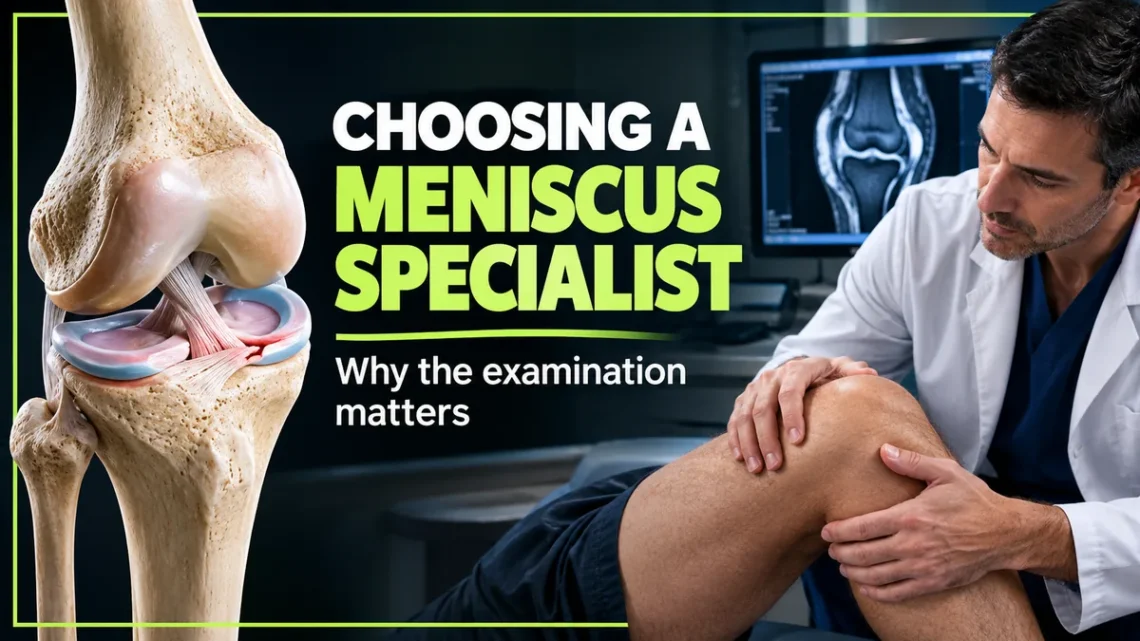
Watch what happens in a careful knee consultation. The doctor crouches down. Two thumbs settle either side of the joint, just below the kneecap, and press. The leg is lifted, bent, rotated slowly inward, then outward. Somewhere in that arc there is a small catch, a hitch you can feel through your own skin, and the doctor stops on it. That pause is the examination.
Now picture a poorer one. The scan comes up on the screen, the report is read aloud, a plan is offered, and nobody touches your leg. Both appointments cost roughly the same and take about the same time. When you are choosing a meniscus specialist, the difference between those two rooms is most of what you are actually choosing between, and it helps to know how to spot it before you sit down.
Hands before pictures
A torn meniscus gives itself away under the hands. There are a handful of manual tests where the examiner bends and twists the joint to see whether a torn edge catches. They are not perfect. But they tell you something no image can, which is whether the tear is producing your symptoms now, today, in this leg.
That matters, because scans find tears in knees that feel perfectly fine. Cartilage thins with age, quietly, and a tear can sit in a joint for years without ever announcing itself. If your specialist has read the picture but never felt the joint move, they know a tear exists. They do not yet know it is your problem.
The scan is not the diagnosis
People often arrive with a private MRI already done, hoping to skip a step. It rarely saves time, and occasionally it costs them.
An image on its own invites a plan built around whatever is visible. Your knee has more to say than that. The catch halfway through a bend, the swelling that arrives the morning after football, the twinge when you roll over in bed, all of it narrows things down.
A careful specialist wants three things in a particular order: the story, the examination, then the picture. The picture confirms. It should not lead.
Ask about the ratio
Here is the question almost nobody asks, and it is the most useful one in the room.
Torn cartilage can be trimmed away or stitched back together. Trimming is quicker and technically simpler. Stitching is fiddlier, takes longer, and commits you both to a slower recovery with more follow-up. Both are legitimate operations, and there are tears that can only be trimmed.
But surgeons differ in how much repair work they do. One who repairs often will look hard for a repairable tear. One who rarely repairs may reach for the trim in a borderline case, sincerely and with no bad intent, simply because that is the operation their hands know best. So ask plainly. Of the meniscus cases you operate on, roughly what share end in a repair rather than a trim? The answer matters, and so does how comfortable they are giving you one.
Who owns your recovery
The operation is a morning. The recovery is months. Ask who is steering it.
A repair comes with rules about how much weight you can put through the leg and how deep you may bend it, and those rules shift week by week. If the plan for afterwards is vague, or amounts to see a physiotherapist, you are being handed the harder half of the job without a map. Good practices will tell you what week eight should look like before you agree to week one.
What to bring with you
Turn up with these five things and you will get a better half hour:
- The moment it happened, if there was one, and what your knee was doing at the time.
- What the knee cannot do now, described as movements rather than as a pain score.
- Whether it locks, catches or gives way, and how often.
- Any earlier scans, reports or physiotherapy notes for that leg.
- What you need the knee to do in six months, said out loud.
That last point is not sentimental. It changes the recommendation.
Answers worth trusting
You can judge a specialist by how they handle uncertainty. A careful one will tell you which parts of your tear are clear and which are not, and what would change the plan. They will describe the option they are not recommending, and why they set it aside.
Someone certain about everything, in a joint as variable as a knee, is a quiet warning sign. So is a plan that never mentions what happens if it does not work.
A knee has no spare. What it needs from you first is not a decision about surgery, but an honest look from somebody who has actually held it, watched it bend, and is willing to say plainly what they do not yet know. Find that person, and every choice that follows gets easier to make.