
Introduction
If you have come across 203.160.175.158.14001, you might be wondering what it is. Just know that it is simply an IP address combined with a port number. It is a good practice to know something even before you get there. Here, you will learn about 203.160.175.158.14001
What is 203.160.175.158:14001?
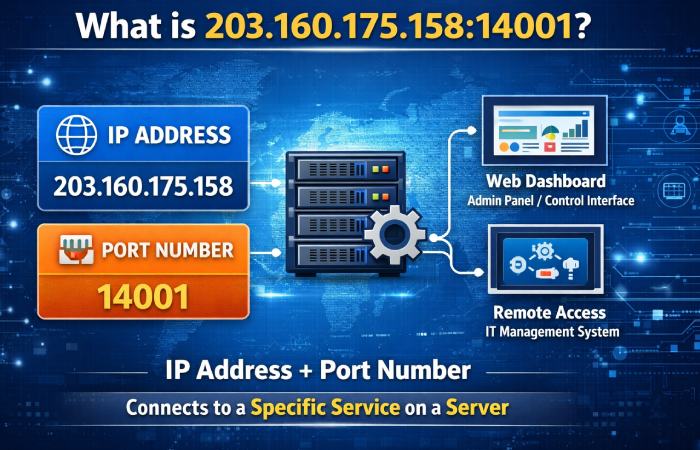
203.160.175.158:14001 is a combination of an IP address and a port number. The initial one, 203.160.175.158, is an IP address, which is a digital home address of a device or server on the internet. It assists computers to locate and interact with one another via the internet.
The second section 14001 is referred to as a port number. A port number is equivalent to a special door within that digital address that enables a particular kind of service or program to send and receive data.
Various ports correspond to various services, e.g. websites, emails, game servers, remote access or other online systems. When you see an IP address with a port number like this, it is most likely that someone is directly communicating with a specific service that is being run on that server.
| Component | Value | Role |
| IP Address | 203.160.175.158 | Identifies the server |
| Port Number | 14001 | Connects to a service |
| Format | IP:Port | Standard structure |
| Access Type | Restricted | Not public-facing |
How Does It Work?
In a case where a system is connected to 203.160.175.158:14001 a sequence of events occur in the background. The device determines the destination server with the IP address first. The data is then directed through various networks until it gets to the relevant machine. Upon its arrival, the port number informs the server what application to handle the request.
The server then checks the request by verifying the request. In the event of authentication, the user should give credentials. Once it is validated, the request is handled and a response is returned to the server. This can be a dashboard or raw data, or any other service on that port.
| Step | Process | Description |
| 1 | Address Recognition | System identifies IP and port |
| 2 | Data Routing | Travels through internet networks |
| 3 | Server Handling | Request reaches target server |
| 4 | Port Assignment | Service on port 14001 responds |
| 5 | Response | Data is sent back to user |
What is Port 14001 Used For?
Port 14001 is not a standard port that has been allocated to the wider community, such as port 80 or 443. Rather, it is classified as non-standard or custom ports, and are frequently employed to provide private or specialized services. Such ports are used by organizations and developers to execute applications that are neither supposed to be seen by the general population.
Since it is not common knowledge, port such as 14001 can also assist in minimizing exposure to automated computer attacks which normally focus on default port. This renders it to be a viable option as an internal tool, a dashboard, and as a testing environment.
| Use Case | Explanation |
| Custom Software | Runs private applications |
| Admin Panels | Internal dashboards |
| Remote Access | IT system control |
| Development Testing | Temporary servers |
| IoT Systems | Device communication |
Possible Uses of 203.160.175.158:14001
No verifiable public data exists regarding this particular address, but it probably has a specialized purpose. Numerous organizations and developers share the IP and port with similar combinations to operate safe services. These may be internal, APIs, or external management tools.
Such addresses in most instances are a controlled environment that has only authorised users who are able to connect. This assists organizations to safeguard confidential information and restrict access to valuable systems.
| Scenario | Description |
| Business System | Internal company tools |
| Web Dashboard | Analytics or admin panel |
| Remote Server | Network management |
| Development Server | Testing environment |
| Private API | Backend service |
Who Uses This Address?
The ownership of 203.160.175.158:14001 is not publicly available. Such addresses are normally used by an organization, hosting provider, or by an IT team. These systems are mostly set up in house functions and have no interaction with the outside world.
In others, the internet service providers may temporarily assign such IPs to use technically. They can also be utilized by developers in staging environments or experiments. It is typically controlled and limited in purpose, irrespective of the owner.
| User Type | Purpose |
| Companies | Internal systems |
| Developers | Testing and deployment |
| IT Teams | Server management |
| Hosting Providers | Cloud-based services |
Is It Safe to Access?
It can be risky to access unknown IP addresses, especially if you don’t know what they’re for. Some of these addresses are safe, but others can put you at risk of security threats if you don’t handle them carefully.
If you come across 203.160.175.158:14001 in the unknown, it’s best not to talk to it. Only go to these addresses if you trust the source and have permission to do so.
| Situation | Recommendation |
| Unknown Source | Avoid access |
| Trusted System | Safe to use |
| Requires Login | Verify credentials |
| No Encryption | Risky connection |
| HTTPS Enabled | More secure |
How to Access It If Authorized
In case you are allowed to enter this address, you will be able to do it by typing its address into the browser or by using a certain program. Nevertheless, it may need logins and adequate network permissions to access it.
You might also be required to make sure that your firewall or Internet provider does not block the port. Custom ports such as 14001 are not allowed in most situations due to security reasons.
| Method | Example |
| Browser Access | http://203.160.175.158:14001 |
| Secure Access | https://203.160.175.158:14001 |
| Software Tool | Custom client |
Why Access Might Fail
There are several technical reasons why you might not be able to connect to this address. The server could be offline, the port may be blocked, or the service might require authentication.
Network restrictions are another common issue. Some ISPs and firewalls block uncommon ports to prevent misuse, which can stop the connection from working.
| Issue | Cause |
| Blocked Port | Firewall restrictions |
| Server Down | Service unavailable |
| Access Denied | Authentication required |
| ISP Blocking | Restricted ports |
| Wrong Protocol | HTTP/HTTPS mismatch |
Conclusion
The 203.160.175.158:14001 combination is an example of a technical network address to access a particular service on a server. The IP address is used to determine the device but the port number is used to deliver the request to the appropriate application.
These are mostly applied in personal systems, business applications and development systems. This particular address has no public information available and, therefore, should not be accessed without the required authorization.
Learning the functionality of IP addresses and ports can save you time and life on the Internet, as well as keep you out of needless problems when you have to deal with unfamiliar network connections.