
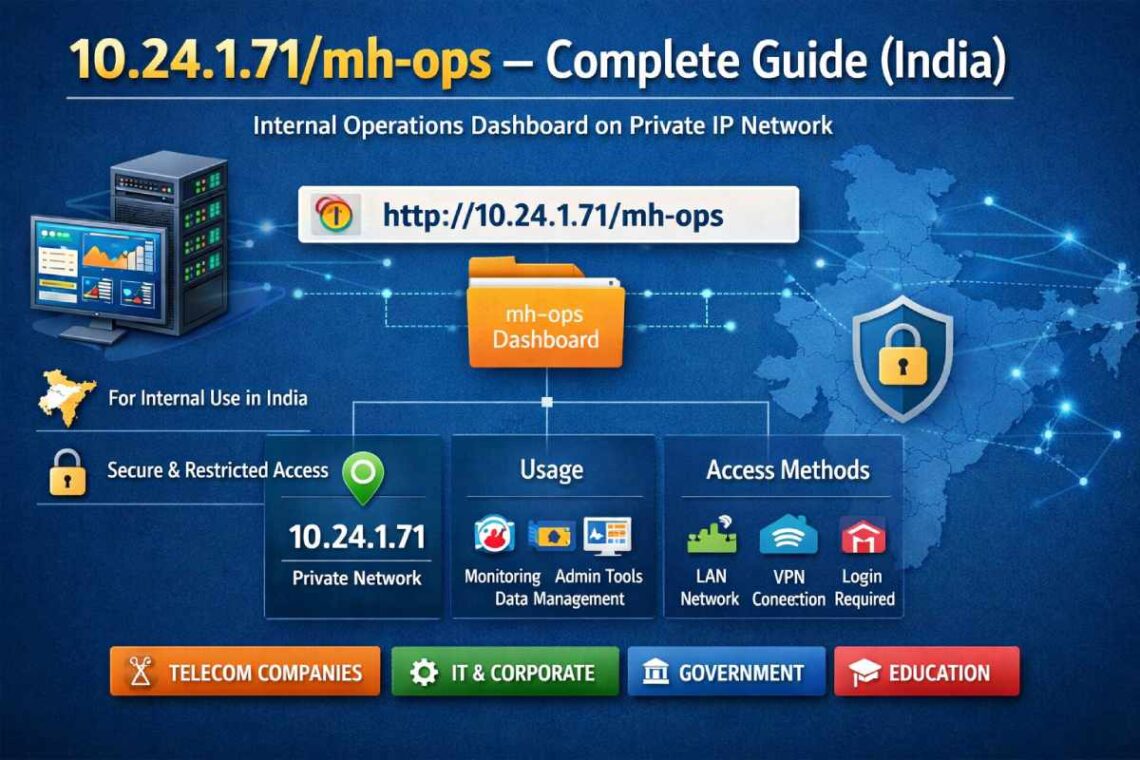
The address 10.24.1.71/mh-ops refers to a private internal network URL that is commonly used within organizations in India. Unlike public websites that anyone can access through the internet, this type of address is designed strictly for internal use within a Local Area Network (LAN) or via a secure VPN connection. It is typically associated with operational dashboards, monitoring tools, or administrative portals used by IT teams, telecom operators, or institutional systems.
At its core, this address combines a private IP (10.24.1.71) with a specific application path (/mh-ops). This structure strongly indicates that the system is part of a centralized operational platform, possibly used to monitor systems, manage data, or control internal workflows. In India, such systems are widely deployed across sectors like telecom, IT services, government infrastructure, and educational institutions.
Understanding 10.24.1.71/mh-ops
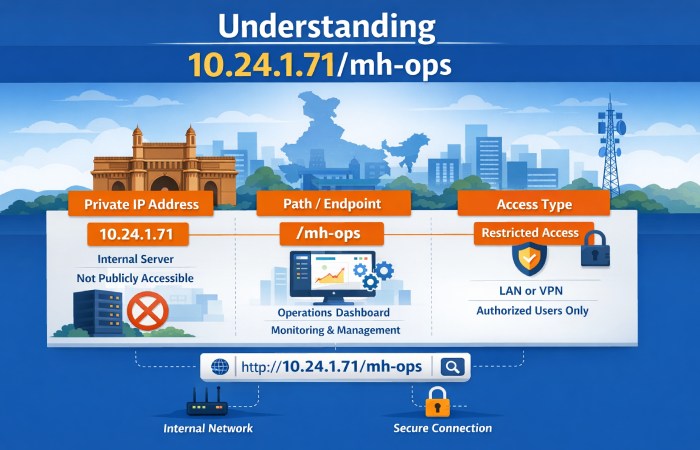
To fully understand this keyword, it is important to break it down into its components. The IP address belongs to the 10.x.x.x private network range, which is reserved for internal usage as defined by networking standards. The “mh-ops” portion typically refers to an operational module, where “OPS” stands for operations and “MH” could represent a regional or functional identifier such as Maharashtra, Main Hub, or Mobile Hub.
Component Breakdown
| Component | Meaning | Description |
| 10.24.1.71 | Private IP Address | Internal server within a network |
| mh-ops | Operations Path | Dashboard or application endpoint |
| Network Type | Private LAN | Not accessible on public internet |
| Access Mode | Restricted | Requires VPN or internal access |
This structure is commonly used in enterprise environments where sensitive operations need to be protected from external exposure.
Role of Private IP Addresses in India
Private IP addresses like 10.24.1.71 play a crucial role in India’s digital infrastructure. Organizations rely heavily on these IPs to build secure internal networks that allow efficient communication and data transfer without exposing systems to external threats.
In sectors such as telecom, IT, and government services, private networks are used to manage everything from customer databases to network performance monitoring. These systems ensure that internal processes remain fast, secure, and controlled.
Public vs Private IP Comparison
| Feature | Public IP | Private IP |
| Accessibility | Global internet | Internal network only |
| Example | 103.x.x.x | 10.x.x.x |
| Security Level | Moderate | High |
| Usage | Websites, apps | Internal tools, dashboards |
Private IPs are particularly important in India due to the scale of enterprise networks and the need for secure digital operations.
How 10.24.1.71/mh-ops Works
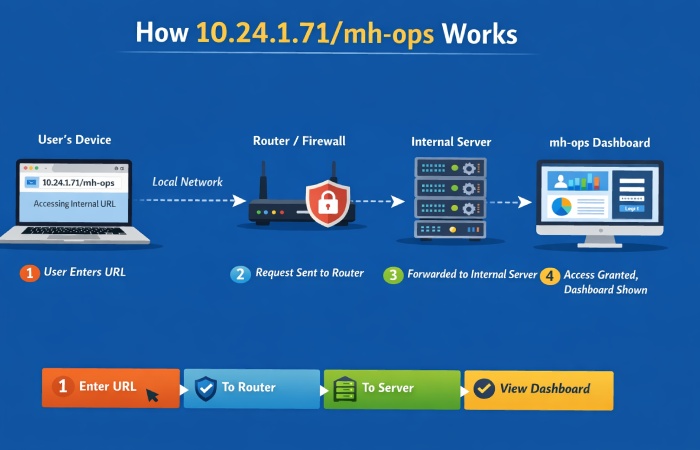
When a user tries to access 10.24.1.71/mh-ops, the request does not travel across the public internet. Instead, it stays within the internal network. This ensures faster response times and enhanced security.
The system typically hosts a web-based dashboard that allows authorized users to log in and perform operational tasks such as monitoring servers, tracking performance metrics, or managing internal data.
Network Workflow
| Step | Process Description |
| 1 | User enters URL in browser |
| 2 | Request goes to local router |
| 3 | Router forwards to internal server |
| 4 | Server processes request |
| 5 | Dashboard or login page appears |
This internal routing mechanism ensures that sensitive systems remain isolated from public access.
Why You Cannot Access It Publicly
Many users attempt to open 10.24.1.71/mh-ops from their home or mobile networks and encounter errors. This happens because private IP addresses are not designed to work outside their designated environment.
The system is protected by multiple layers of security, including firewalls and access control mechanisms. In most cases, access is only granted to users who are connected to the organization’s internal network or VPN.
Common Access Limitations
| Issue | Explanation |
| Not reachable | Outside the internal network |
| Access denied | No authorization |
| Timeout | Server not accessible remotely |
| Blocked by firewall | External traffic restricted |
How to Access 10.24.1.71/mh-ops
To access this system, users must follow specific conditions. Typically, organizations provide access through secure channels to ensure data protection.
Users can connect through a local office network or use a Virtual Private Network (VPN) to securely log in from remote locations. Authentication credentials are usually required to ensure that only authorized personnel can use the system.
Access Methods
| Method | Requirement |
| LAN Access | Must be inside office network |
| VPN Access | Secure remote login |
| Credentials | Username and password |
| Admin Approval | Required for permissions |
Security Features of mh-ops Systems
Systems like mh-ops are designed with strong security protocols to protect sensitive information. Since they handle critical operational data, organizations implement multiple layers of protection.
These include encrypted communication, user authentication, and strict access controls. Such measures ensure that unauthorized users cannot gain entry to the system.
Security Measures
| Feature | Purpose |
| Firewall | Prevents unauthorized access |
| VPN | Secures remote connections |
| SSL/TLS | Encrypts data transmission |
| Role-Based Access | Limits user permissions |
Security is a top priority, especially in India where digital infrastructure is rapidly expanding and cyber threats are increasing.
Real-World Usage in India
In India, internal URLs like 10.24.1.71/mh-ops are widely used across industries. Telecom companies use them to monitor network performance, while IT companies rely on them for server management and DevOps operations.
Government organizations also use similar systems for administrative tasks and data management. Educational institutions deploy internal portals for managing attendance, records, and communication.
These systems form the backbone of many critical operations, enabling organizations to function efficiently and securely.
Benefits of Internal Systems Like mh-ops
Internal operational systems provide several advantages that make them essential for modern organizations. They allow centralized management, improve efficiency, and enhance security.
By keeping systems within a private network, organizations can reduce risks and ensure better performance.
Key Benefits
| Benefit | Description |
| Efficiency | Faster internal communication |
| Security | Limited external exposure |
| Reliability | Stable system performance |
| Control | Centralized management |
Technical Insight: Private IP Ranges
Private IP addresses follow specific ranges defined by global networking standards. These ranges are reserve exclusively for internal use and cannot be accessed from the public internet.
Private IP Ranges
| Range | Usage |
| 10.0.0.0 – 10.255.255.255 | Large enterprise networks |
| 172.16.0.0 – 172.31.255.255 | Medium networks |
| 192.168.0.0 – 192.168.255.255 | Small/home networks |
The IP 10.24.1.71 falls within the largest range, typically used by large organizations in India.
Challenges of Using Internal Systems
While internal systems offer many benefits, they also come with certain challenges. One of the main limitations is restricted accessibility, which can make remote work difficult without proper VPN setup.
Additionally, system downtime or misconfiguration can disrupt operations, and managing large networks requires skilled IT teams.
Future of Internal Network Systems in India
India is rapidly advancing in digital transformation, and internal systems like mh-ops are evolving as well. Many organizations are moving towards cloud-based platforms and hybrid infrastructure, which combine the benefits of private networks with the flexibility of cloud computing.
Despite this shift, private IP-based systems will continue to play a vital role in secure operations, especially for sensitive and mission-critical applications.
Conclusion
The keyword 10.24.1.71/mh-ops represents a secure internal operations system hosted on a private IP address. It is widely use in India across various industries to manage internal processes, monitor systems, and ensure efficient operations.
Understanding how it works helps users troubleshoot access issues, maintain security, and better utilize internal tools. While it may not be accessible publicly, it remains a crucial part of modern organizational infrastructure.